 Leak Fix Pros
How Leak Detection Works: Acoustic, Thermal and Tracer Gas Methods
Modern leak detection is mostly measurement. Providers combine sound, heat and gas to find a leak to within inches, so they open as little as possible.
Short answer: Acoustic detection listens for the sound of pressurized water escaping. Thermal imaging reads temperature differences on a surface. Tracer gas fills an emptied line with a safe gas and detects where it escapes. Providers pick one or combine them depending on the pipe, the material above it and what the first tests show.
Acoustic sound testing
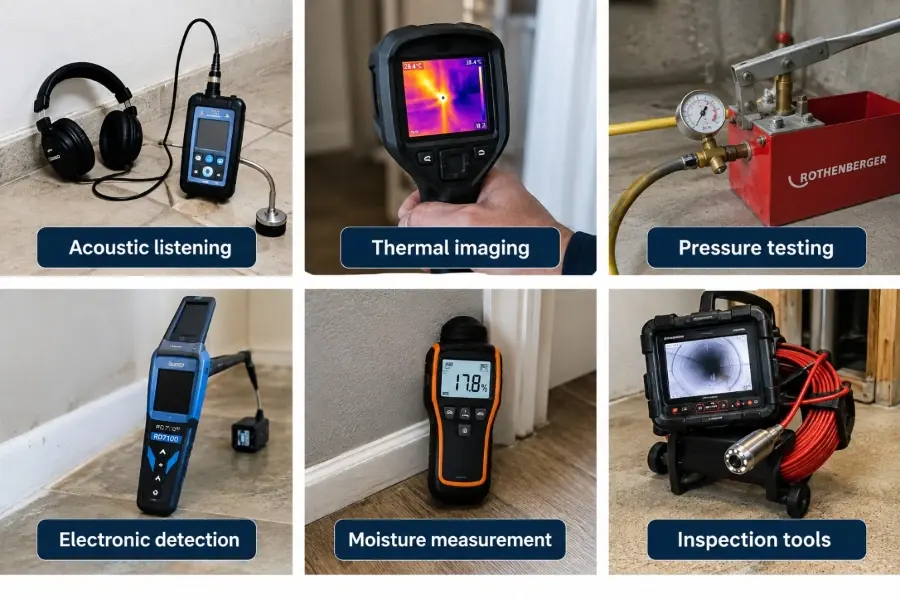
Water escaping from a pressurized pipe makes a sound, even if it is too faint for a person to hear. Acoustic equipment uses sensitive microphones placed on the floor, wall or ground. Some systems also use a pair of sensors on a pipe to calculate the leak's distance from each one. The provider listens for the point where the noise is loudest, which is usually directly above the leak.
It works best on pressurized supply lines and is used for slabs, yards and walls. It is less reliable on plastic pipe, which carries sound poorly, and in noisy environments such as busy streets or running equipment. That is one reason providers rarely rely on sound alone. See slab leak detection and buried yard line leaks, where acoustic work is common.
Thermal infrared imaging
A thermal camera records infrared energy and displays temperature differences as colors. It does not see inside walls. It shows the temperature of the surface, and that can reveal a leaking hot water line warming a floor, or moisture cooling a wall as it evaporates.
Results depend on the materials and the conditions, so thermal findings are leads to be verified. It is useful for large areas because it can scan a ceiling, wall or floor quickly, which makes it a standard first step for hidden wall and floor leaks.
Tracer gas detection
In tracer gas detection, a provider drains the suspect line and fills it with a non-toxic gas mixture. A common one is a small amount of hydrogen in nitrogen. The gas escapes through the leak and rises through the structure, and a sensitive handheld detector at the surface reads where the concentration peaks.
It is slower and used less often than sound or heat, but it can confirm a leak when other methods are inconclusive, including in plastic pipe or under thick floors. It also suits pool plumbing and slab lines; see pool and spa leak detection.
Which method for which problem
| Situation | Usual starting method | Often confirmed with |
|---|---|---|
| Pressurized supply line under a slab | Acoustic listening | Thermal imaging or tracer gas |
| Stain or damp area on a wall or ceiling | Moisture meter and thermal imaging | Acoustic listening and pressure test |
| Buried yard or service line | Acoustic listening | Tracer gas or pressure test |
| Pool plumbing lines | Pressure test and dye | Tracer gas or listening |
| Sewer or drain line | Video camera | Dye or smoke test, if needed |
| Hot water line leak | Thermal imaging | Acoustic listening |
Pressure testing and moisture meters round out the kit. Pressure testing isolates a section of pipe and sees whether it holds pressure. Moisture meters measure how wet building materials are. Drain and sewer lines are not pressurized, so they use cameras; see sewer video inspection.
How accurate is it?
Accuracy depends on the pipe, the depth, the materials above it and the provider's experience. A good provider can usually mark a leak location to within a small area on the surface, then verify with a second method. Ask how they confirm the location and whether they will show you the readings. Honest providers explain the limits too, such as plastic pipe and deep lines.
Whichever tools they use, the goal is the same as in any professional leak detection service: find the leak first, then open the smallest possible area to fix it. For repair options once the leak is found, see leak repair and pipe lining.
Questions to ask a provider
- Which methods will you use, and why those for my situation?
- How will you confirm the leak location before anything is opened?
- Will I receive photos, readings or a written report?
- Is the detection fee separate from repair, and is it credited if I hire you for the repair?
- Are you licensed for the repair work you propose? (Ask for the license number and check it on the California Contractors State License Board site at cslb.ca.gov.)
Frequently asked questions
How do professionals find hidden leaks?
They use moisture meters, thermal imaging, acoustic listening, pressure testing and tracer gas, often in combination. The first tests narrow the area and the others confirm the exact spot.
How accurate is professional leak detection?
Accuracy varies with the pipe, depth and conditions. Experienced providers typically verify a result with a second method before anything is opened.
Is tracer gas safe?
The standard mixture used for leak detection is a small proportion of hydrogen in nitrogen, which is non-toxic and non-flammable at that ratio. The provider handles the process and ventilation.
Does thermal imaging see through walls?
No. A thermal camera shows surface temperature. It can point to a leak behind a wall when the leak causes a temperature difference at the surface.
Can leak detection be done without breaking my floor, slab or driveway?
In most cases the location is found from the surface. A small opening is only made at the confirmed point if you choose a spot repair.
Related services
- Slab Leak DetectionFind a leaking line under or inside a concrete foundation without guessing.
- Hidden Wall & Floor LeaksStains, bubbling paint or a musty smell with no visible drip: trace the source.
- Pool & Spa Leak DetectionWater level dropping faster than it should? Separate evaporation from a real leak.
- Irrigation & Yard LeaksSoggy patches, misting sprinklers or a buried service line leaking before the house.