 Leak Fix Pros
Hidden Wall and Floor Leak Detection in Whittier
Water that leaks inside a wall, ceiling or floor assembly can travel a long way before it shows. Finding the true source, not just the stain, is what keeps you from repairing the wrong spot.
Short answer: Hidden wall and floor leaks are found by combining moisture meters, thermal imaging, acoustic listening and pressure testing to trace water back to its source. A stain on a ceiling or baseboard is often several feet from the actual leak, so providers measure first and open drywall last, if at all.
Why the stain is rarely where the leak is
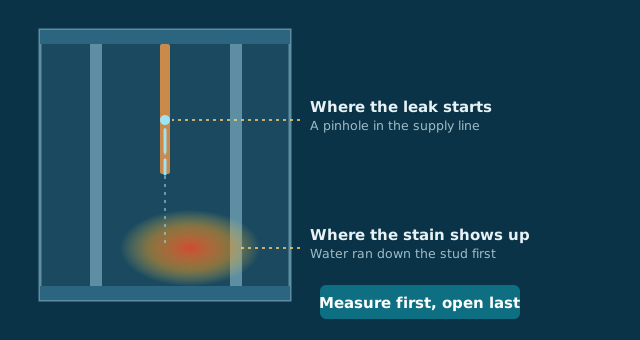
Water follows gravity and the path of least resistance. A supply line leaking inside a wall can run down a stud, along a plate and out through a gap near a baseboard several feet away. A shower pan or tub drain leak can darken the ceiling of the room below. A leaking appliance supply line can saturate subfloor before any surface material shows damage.
That is why patching the stain does not fix anything. A reliable leak detection service in Whittier treats the stain as a clue, then works back along the likely paths to the actual fitting, joint or pipe.
Signs of a hidden leak
- Paint that bubbles, peels or shows a brown ring on a wall or ceiling.
- Baseboards that swell, lift or separate from the wall.
- Hardwood or laminate that cups, buckles or gaps along a seam.
- A musty smell or visible mold in a closet, cabinet or corner.
- Warm patches on a wall or floor that line up with a hot water line.
- Water noise inside a wall when no fixture is running.
- A meter that moves with all water off, which means the leak is under pressure, not only a drain problem.
If the meter does not move but you still see damage, the source may be a drain or waste line, a shower pan, a roof or window leak, or an appliance connection that only leaks when the appliance runs. A good provider will ask when the damage appears, because timing separates these cases quickly.
Tools used to trace the source
No one tool finds every hidden leak. Providers choose from a set and combine them:
| Tool | What it shows | Best for |
|---|---|---|
| Moisture meter | Moisture content in drywall, wood and flooring | Mapping how far water has spread |
| Thermal imaging camera | Temperature differences on a surface | Warm hot-water leaks and cool evaporating moisture |
| Acoustic listening | The sound of pressurized water escaping | Supply lines inside walls and floors |
| Pressure testing | Whether an isolated line holds pressure | Confirming which line is leaking |
| Tracer gas | A gas escaping at the exact leak point | Hard-to-confirm leaks after other methods |
Each of these is explained on our leak detection methods page. Thermal imaging in particular is often misunderstood: the camera reads surface temperature, it does not see through walls.
What happens on a visit
- Walk the damage
The provider asks when you first noticed it and whether it changes when certain fixtures or appliances run. - Map the moisture
A moisture meter and thermal camera outline the affected area without cutting anything. - Test the lines
Supply lines are pressure tested and listened to. Drain and appliance connections are checked separately. - Confirm the source
When the source is narrowed down, a small inspection opening may be proposed. Many providers can mark the exact spot so the opening is small. - Document and advise
You get the finding, the location and the recommended next step. If you plan an insurance claim, ask for a written report.
Cost and what to ask
Price depends on the size of the area, how many systems must be tested and whether the damage needs a moisture survey. Providers set their own rates. Before agreeing to a visit, ask whether the quote covers pinpointing the source, whether any opening and patching is included, and whether you receive a report. If the leak is on a line that is also serving a sink or fixture, the visit can overlap with fixture leak testing.
When to call
Call when you see new staining, swelling or odor and cannot match it to a source. Acting early limits material damage, and early moisture mapping often keeps the opening to a small patch instead of a whole wall. If the area is near electrical outlets or the ceiling is sagging with water, keep people out of the room and shut off the main water valve if you can reach it safely. Older homes in places like the Hadley-Greenleaf Historic District and Uptown Whittier often have walls where gentle, non-destructive diagnosis is especially valuable.
Frequently asked questions
Can plumbers detect hidden leaks behind walls?
Yes. Providers use moisture meters, thermal imaging, listening devices and pressure tests to find leaks inside walls without removing drywall. A small opening may still be recommended once the location is narrowed down.
How do I tell what is leaking behind a wall?
Check the water meter with all water off. If it moves, a supply line is leaking. If it does not, the source may be a drain line, a shower pan, an appliance connection or an exterior leak. A provider can sort this out with a short set of tests.
Can a leaking toilet or shower cause damage in a different room?
Yes. A toilet seal, tub drain or shower pan leak can show up as ceiling staining in the room below or as a damp wall on the other side of a bathroom.
Does thermal imaging find every leak?
No. Thermal cameras show surface temperature patterns that can point to a leak, but results depend on the materials, the temperature difference and the conditions. Providers confirm findings with other methods.
Should I open the wall myself?
Not before measuring. Opening drywall in the wrong place adds repair work and can hide the evidence a provider needs. A moisture and thermal scan first usually leads to a smaller, better-placed opening.
Related services
- Acoustic, Thermal & Tracer GasHow leak detection works, and which method is used for which problem.
- Slab Leak DetectionFind a leaking line under or inside a concrete foundation without guessing.
- Insurance Claim ReportsWritten leak findings with location, method and photos to support a claim.
- Leak Repair, Pipe Lining & Smart ValvesTargeted repair after detection, trenchless pipe lining, and smart shutoff valves.